
Farm Bikes and Farm Vehicles NZ: Quads, Two‑Wheelers & Side‑by‑Sides Farmers Rely On
Spend enough time helping farmers with petrol tax refund claims and you start to notice a pattern: the same hard‑working farm vehicles show up again and again. This blog takes a practical look at the farm bikes and farm vehicles that consistently turn up in the paperwork - the real workhorses of the farm.
We’ll kick things off with the quad bikes, including familiar names like the TRX420 that seem to feature on almost every second claim. Then we’ll move into the two‑wheelers, with steady performers such as the Suzuki DR200 that remain a common sight across all kinds of terrain. After that, we’ll cover the side‑by‑sides, from everyday runabouts through to the more capable options like the Can‑Am Defender.
And if you read through to the end, there’s an honourable mention that isn’t exactly a curveball - more of a familiar favourite that always seems to find its way onto rural properties.
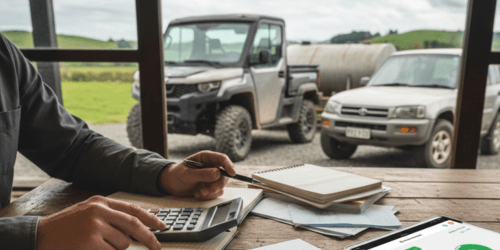
Are You Leaving Money in the Paddock?
Every litre of petrol you put into your quads and side-by-sides qualifies for an NZTA refund. Use our 30-second calculator to see what you're owed.
- Initial payment backdated 1 month: $0.00
- Ongoing quarterly payments: $0.00
Quad Bikes NZ: Comparing the Honda TRX420, Suzuki KingQuad and Can‑Am Outlander
Quad bikes show up in petrol tax refund claims more than almost anything else, and the Honda TRX420, Suzuki KingQuad, and Can‑Am Outlander are the three farm bikes that appear the most. The chart below lays out the key specs - fuel use, range, engine details, towing capacity, rack limits, gears and ground clearance, so you can quickly see how they compare before getting into the individual breakdowns.
| Farm Quad Comparison | Can-Am Outlander PRO | Suzuki KingQuad 500AXi | Honda TRX420 Rancher |
|---|---|---|---|
| Fuel Tank Capacity | 19.5 Litres | 17.5 Litres | 14.7 Litres |
| KM per Litre (Est.) | 7 to 9 km/L | 7 to 9 km/L | 8 to 10 km/L |
| Est. Range (Mixed Work) | 145 – 160 km | 120–140 km | 110–130 km |
| Engine / HP | 650cc / 40 HP | 38 hp (493cc) | 420cc / 27 HP |
| Towing Capacity | 830 kg | 600 kg | 385 kg |
| Rack Capacity (F/R) | 54 kg / 109 kg | 30 kg / 60 kg | 30 kg / 60 kg |
| Gears | Automatic | Automatic | Manual or Auto |
| Ground Clearance | 330 mm - Higher clearance | 260 mm | 233 mm |
The Can-Am Outlander PRO
This is for the farmer moving heavy gear. It has the highest towing and rack capacity in its class. The 2025 model uses a "pDrive" clutch that requires much less maintenance than older CVTs, and the engine is tilted backward to keep the heat away from the rider's legs - a huge plus in summer.
The Suzuki KingQuad 500
Often called the "best-balanced" quad. It doesn’t lead in any one spec, but it’s incredibly comfortable for long days in the saddle. Its independent suspension is famous for being "plush," making it the go-to for checking fences on rough, rutted ground.
The Honda TRX420
This is the "never-die" option. Unlike the others, Honda offers a gear-driven transmission (no rubber belt to slip or snap). If you’re constantly pulling heavy loads through deep mud or up steep hills where belts usually fail, the TRX420 is the "tried and true" king.
Two‑Wheeler Farm Bikes NZ: Yamaha AG200, Suzuki DR200 & Honda XR150
Two‑wheelers are another common sight in petrol tax refund claims, with the Yamaha AG200, Suzuki DR200, and Honda XR150 showing up more than most. They’re light, efficient and built for everyday farm work, and the chart below lays out the key details - fuel use, range, engine specs, weight, rack capacity, transmission and ground clearance - before you get into the individual breakdowns.
| 2-Wheeler Comparison | Yamaha AG200 | Suzuki DR200 Trojan | Honda XR150L |
|---|---|---|---|
| Fuel Tank Capacity | 10.0 Litres | 13.0 Litres | 12.0 Litres |
| KM per Litre (Est.) | 25 to 30 km/L | 30 to 35 km/L | 35 to 40 km/L |
| Est. Range (Mixed) | 250 – 300 km | 350 – 400 km | 400 – 450 km |
| Engine / HP | 196cc / ~14 HP | 199cc / ~20 HP | 149cc / ~12 HP |
| Curb Weight | 128kg | 132kg | 129kg |
| Rack Capacity | Front & Rear (20kg R) | Heavy Duty Front & Rear | Rear Only (Standard) |
| Transmission | 5-Speed Manual | 5-Speed Manual | 5-Speed Manual |
| Ground Clearance | 255 mm | 260 mm | 245 mm |
The Yamaha AG200
This is the only bike in its class designed from the ground up for farming, not just a trail bike with racks added. It features a fully enclosed chain case that keeps mud out and drastically reduces maintenance. Its "Dual Side Stands" and unique clutch lock make it the easiest bike to park on hills while you jump off to open a gate.
The Suzuki DR200 Trojan
Known as the powerhouse of the ag bikes, the Trojan is built for tough hill country. It carries a 13litre fuel tank - the largest in the group, and comes with a front disc brake for better stopping power on steep descents. With heavy duty headlight protection and alloy hand guards, it’s the most rugged choice for mustering through thick scrub.
The Honda XR150L
This is the "value and comfort" king. It is a modern, fuel-sipping runabout that is significantly quieter and smoother than traditional ag bikes. While it lacks a clutch lock, its 149cc engine is the most fuel-efficient on the list, making it the perfect choice for high-frequency, light-duty tasks where low running costs are the priority.
Side‑by‑Sides NZ: Honda Pioneer 700, Polaris Ranger SP 570 & Can‑Am Defender HD7
The Honda Pioneer 700, Polaris Ranger SP 570, and Can‑Am Defender HD7 are the side‑by‑sides that show up most often in petrol tax refund claims - bigger, stronger and more comfortable than a quad, with the tray space to match. We’ve also included the 1990’s Toyota RAV4 as an honourable mention; its lightweight 4WD setup still earns it a place on plenty of rural properties. The chart below compares the essentials so you can see how the modern workhorses - and one 90s classic - stack up at a glance.
| Side by Side Comparison | Honda Pioneer 700 | Polaris Ranger SP 570 HD | Can-Am Defender HD7 | Honourable Mention – 4WD Toyota RAV4 |
|---|---|---|---|---|
| Fuel Tank Capacity | 31.0 Litres | 35.9 Litres | 40.0 Litres | 58 Litres |
| KM per Litre (Est.) | 6 to 8 km/L | 5 to 7 km/L | 5 to 7 km/L | 9 to 11 km/L |
| Est. Range (Mixed) | 180 – 210 km | 180 – 230 km | 200 – 260 km | 550 – 600 km |
| Engine / HP | 675cc / ~36 HP | 567cc / 44 HP | 650cc / 52 HP | 2.0L Petrol / ~127 HP |
| Tray Capacity | 454 kg | 227 kg | 454 kg | 415 kg |
| Transmission | Auto (Steel Gears) | Auto (Belt) | Auto (Belt) | 5-Speed Manual or 4-Speed Auto |
| Ground Clearance | 270 mm | 279 mm | 280 mm | 205 mm |
The Honda Pioneer 700
This is the "no-belt" champion. Because it uses a car-style automatic transmission with steel gears, it is incredibly efficient for heavy towing. It’s the best choice for farmers who want to avoid the maintenance costs of rubber belts while maintaining great fuel economy under load.
The Polaris Ranger SP 570
Known for being the nimblest in its class, the Ranger features "Turf Mode," which allows the rear wheels to spin at different speeds so you don't tear up your grass. It’s the lightest UTV on the list, making it a great fuel-efficient choice for zipping around the yard or lighter paddock work.
The Can-Am Defender HD7
Built for the big jobs, the Defender has the most horsepower and the largest fuel tank in this category. It’s designed to stay out in the back blocks all day without needing a refill. While it is the heaviest and thirstiest machine, its "Work-Tuned" transmission makes it incredibly smooth for low-speed tasks.
The 1994 Toyota RAV4
The original "Side-by-Side" before they were even a thing. While it lacks the ground clearance of a modern UTV, its permanent 4WD system and 127 HP engine make it a surprisingly capable farm hack. It’s the only option here with a heater and a radio, making those winter morning water-runs much more bearable.
From Smart Machines to Smart Business
If you’re looking at these numbers to save on fuel, you’re exactly the type of person who shouldn't be leaving money on the table. Every litre of petrol used in these quads, side-by-sides, and bikes is eligible for a fuel excise duty refund - money that belongs back in your pocket.
Stop Leaving Your Rebates in the Paddock The savings from an efficient bike are great, but the real value is claiming your 76 cents per litre (GST exclusive) refund. Most farmers miss out because the quarterly paperwork is a headache or just dont have the time.
We take care of the admin so you can stay focused on the farm. We offer the lowest rates on the market of only 15%, whether you’re running a new Can-Am Defender or a classic '94 RAV4, we’ll make sure you get your money back.
Staying safe? Download our Free Quad Bike Safety Checklist for NZ Farmers here:
